My name is Grace, and I’m twenty-nine years old, a single mother raising the bravest little girl I’ve ever known. My daughter Lily is four, with soft curls that never quite stay brushed and eyes that light up whenever she talks about dinosaurs or princesses or both at the same time. She laughs easily, loves fiercely, and fights harder than anyone ever should have to at her age. What happened to us that day didn’t start with cruelty. It started with obsession. Obsession with appearances, with favoritism, with a family hierarchy that had been quietly suffocating us for years.
Lily was born prematurely at twenty-eight weeks and diagnosed with severe bronchopulmonary dysplasia shortly after. The doctors were honest with me in a way that still echoes in my mind. They told me she might not survive her first year. They explained oxygen saturation, fragile lungs, and complications that could linger for life. I learned medical terminology faster than I ever wanted to, learned how to read monitors, learned how to stay calm when alarms went off in the middle of the night. Lily survived. She fought. She kept breathing. But she needed help, and she still does. Supplemental oxygen isn’t optional for her. It’s not comfort. It’s not convenience. It’s survival.
Her father, Jake, didn’t stay long enough to learn any of that. When the hospital bills piled up and the reality of our life became unavoidable, he packed a bag and said he didn’t sign up for this. He left three years ago and never looked back. From that moment on, it was just Lily and me. We learned how to make do, how to stretch paychecks, how to celebrate small victories like stable oxygen levels and a good night’s sleep. Our life isn’t glamorous, but it’s full of love, and for me, that has always been enough.
My parents, Dorothy and Kenneth, never saw it that way. They care deeply about image, about how things look from the outside. The kind of people who smile wide in public and judge quietly in private. My older sister Vanessa has always fit perfectly into the life they imagined for their children. Married to a successful lawyer. Three healthy kids. Big house. Perfect holiday photos. She’s the daughter they brag about. I’m the one they tolerate.
From the moment Lily was diagnosed, my parents treated her condition like an inconvenience instead of a tragedy. My mother asked why she couldn’t just be fixed, as if there were a switch I had refused to flip. My father avoided conversations about her health altogether, changing the subject whenever oxygen or hospital visits came up. Over the years, their comments became sharper. They talked about how expensive Lily must be, how difficult it was for everyone else to accommodate her needs, how maybe she would be better off somewhere more equipped to handle children like her. They never offered help. Not financially. Not emotionally. Not even curiosity.
Vanessa’s children, meanwhile, were celebrated for everything. Piano recitals, soccer games, kindergarten graduations. The whole family showed up, cameras ready, applause waiting. When Lily took her first steps at three years old, delayed because of muscle weakness and lung issues, my parents nodded politely and went back to discussing Vanessa’s vacation plans. I learned to swallow the hurt because I wanted Lily to know her family. I wanted her to feel included, even when it hurt me.
That hope led us straight into the moment that changed everything.
Thanksgiving had barely ended when Vanessa announced she’d be bringing her family to visit for Christmas. My parents reacted like royalty had confirmed a state visit. My mother immediately launched into planning mode, declaring that the house needed to be scrubbed top to bottom. Fresh flowers. New linens. Everything perfect. She spoke about standards and impressions, about how Vanessa’s children were used to a certain level of cleanliness. The implication was clear. Lily and I lowered the tone of the house.
As the days passed, my mother’s demands escalated. Lily’s toys were removed from shared spaces. Her medical supplies, which were always kept accessible in case of emergencies, were labeled unsightly and hidden away. Every trace of our daily life was erased in preparation for Vanessa’s arrival. I told myself it was temporary. I told myself Lily wouldn’t notice.
The morning Vanessa was due to arrive, Lily was having a bad day. She hadn’t slept well, her oxygen saturation was lower than usual, and she needed her nasal cannula almost constantly. I brought her to my parents’ house because my mother insisted everyone needed to be there for final preparations. Lily sat quietly in the living room, coloring dinosaurs with careful concentration while her oxygen concentrator hummed beside her. She wasn’t in the way. She wasn’t causing trouble. She was breathing.
My mother stormed into the room, eyes scanning every surface with sharp disapproval. She adjusted pillows that didn’t need adjusting, muttered about dust that wasn’t there, and then her gaze landed on Lily. She announced that Lily needed to help with cleaning, as if this were a reasonable request. I told her Lily was struggling that day, that she needed to stay on her oxygen. My mother waved me off, dismissive, confident, irritated.
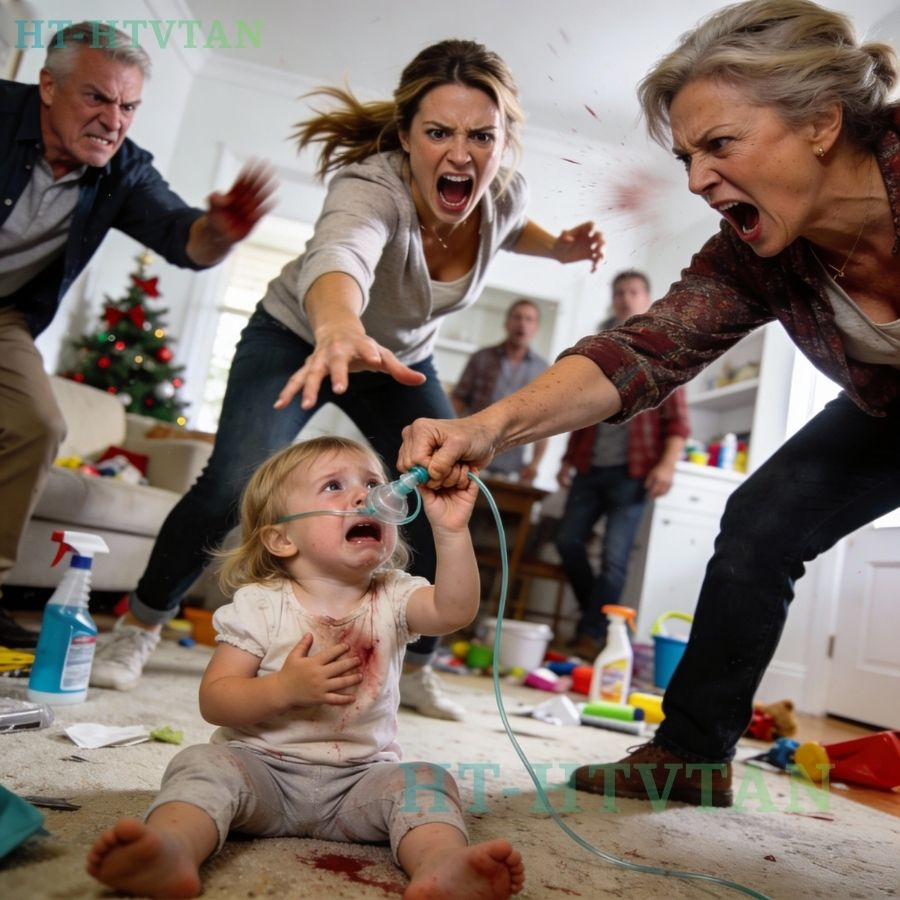
Before I could react, she crossed the room and ripped the nasal cannula from Lily’s face.
The sound Lily made wasn’t loud. It was sharp and scared, a gasp that cut straight through me. My mother held the tubing away and shouted at my four-year-old daughter to start cleaning. Lily’s eyes went wide. Her breathing turned frantic. I saw the familiar blue tint creeping into her lips, the sign every parent of a medically fragile child dreads.
I ran to them, my heart pounding so hard it hurt. I begged. I explained. I told my mother Lily could pass out, that she might not survive without her oxygen. She didn’t listen. She accused Lily of being dramatic. She said children were manipulative. My father entered the room and immediately sided with her, irritation etched across his face as if Lily’s struggle were a personal inconvenience.
I pointed out the signs. I pleaded with him to look at his granddaughter. To really look. I told him she could die. That word, die, was the only thing that finally broke his patience. His hand came across my face in a slap so sudden it left me dizzy. He ordered me to stand down. He said my sister was coming and nothing mattered more than being ready.
I tasted blood. My ears rang. Across the room, my daughter struggled to breathe.
My mother folded her arms, satisfied, and said some children needed to learn family priorities. In that moment, everything became clear. Lily and I were expendable. Appearance mattered more than life. I stopped arguing. Not because I agreed, but because Lily was running out of time.
I stepped toward my mother and gently but firmly took the nasal cannula from her hand.
I immediately…
Continue in C0mment
(Please be patience with us as the full story is too long to be told here, but F.B. might hide the l.i.n.k to the full st0ry so we will have to update later. Thank you!)
My name is Grace, and I’m a 29-year-old single mother to the most precious little girl in the world, Lily.
Lily is four years old and has been battling a severe case of broncomonary dysplasia since she was born prematurely at 28 weeks. The doctors told me she might not make it through her first year, but my fighter proved them wrong. She’s been on supplemental oxygen for most of her life, and while she’s made incredible progress, she still needs her nasal canula for several hours each day to maintain proper saturation levels.
Her case is more severe than typical BPD cases with ongoing complications that require continued oxygen support. Living as a single mom with a medically complex child isn’t easy. Lily’s father, Jake, walked out when the medical bills started piling up, and the reality of our situation hit him. I didn’t sign up for this, he said as he packed his bags.
That was 3 years ago, and we haven’t heard from him since. It’s been just Lily and me against the world, and honestly, we’ve been doing pretty well considering everything we’ve been through. My parents, Dorothy and Kenneth, have always been complicated. They’re the type of people who care more about appearances than substance, more about what the neighbors think than what’s actually happening in their own family.
My older sister, Vanessa, has always been their golden child. She’s married to a successful lawyer named Marcus, has three perfectly healthy kids named Madison, Connor, and Tyler, and lives in a McMansion in the suburbs. She’s everything they wanted in a daughter, and I’m everything they didn’t. When Lily was diagnosed, my parents reaction wasn’t what you’d expect from grandparents.
https://googleads.g.doubleclick.net/pagead/ads?gdpr=0&client=ca-pub-3619133031508264&output=html&h=280&slotname=4148258797&adk=941098857&adf=2087582467&pi=t.ma~as.4148258797&w=850&fwrn=4&fwrnh=100&lmt=1768750288&rafmt=1&format=850×280&url=https%3A%2F%2Fkok2.ngheanxanh.com%2Fhienthucbtv%2Fas-my-parents-heard-that-my-sister-was-coming-with-her-kids-my-mother-started-telling-everyone-to-clean-the-house-as-my-four-year-old-daughter-was-on-her-supplemental-oxygen-she-ran-up-to-her-and-s%2F&fwr=0&fwrattr=true&rpe=1&resp_fmts=3&aieuf=1&aicrs=1&uach=WyJXaW5kb3dzIiwiMTkuMC4wIiwieDg2IiwiIiwiMTQzLjAuNzQ5OS4xOTQiLG51bGwsMCxudWxsLCI2NCIsW1siR29vZ2xlIENocm9tZSIsIjE0My4wLjc0OTkuMTk0Il0sWyJDaHJvbWl1bSIsIjE0My4wLjc0OTkuMTk0Il0sWyJOb3QgQShCcmFuZCIsIjI0LjAuMC4wIl1dLDBd&abgtt=6&dt=1768750203683&bpp=1&bdt=842&idt=28&shv=r20260115&mjsv=m202601130101&ptt=9&saldr=aa&abxe=1&cookie=ID%3Ddbd93e92712e3f2f%3AT%3D1768192396%3ART%3D1768749950%3AS%3DALNI_MaRV89YcrR_EKYg6ziPsHS0klGD7g&gpic=UID%3D000011e2e2df457e%3AT%3D1768192396%3ART%3D1768749950%3AS%3DALNI_MaZLcrf37vb_AZUDJOErZ86I_m5Ow&eo_id_str=ID%3D16d046f8a325110d%3AT%3D1768192396%3ART%3D1768749950%3AS%3DAA-AfjZ2sOYVgNOaQTHnA0WzxSJ5&prev_fmts=0x0%2C1200x280%2C1200x280%2C850x280%2C1425x765&nras=3&correlator=4229821481612&frm=20&pv=1&u_tz=420&u_his=2&u_h=900&u_w=1440&u_ah=852&u_aw=1440&u_cd=24&u_sd=1&dmc=8&adx=113&ady=5579&biw=1425&bih=765&scr_x=0&scr_y=2553&eid=95376583%2C95378425%2C95344787&oid=2&pvsid=4165747183921708&tmod=1762900517&uas=3&nvt=1&ref=https%3A%2F%2Fl.facebook.com%2F&fc=1920&brdim=0%2C0%2C0%2C0%2C1440%2C0%2C1440%2C852%2C1440%2C765&vis=1&rsz=%7C%7CeEbr%7C&abl=CS&pfx=0&fu=128&bc=31&bz=1&pgls=CAEaAzYuOQ..&ifi=3&uci=a!3&btvi=2&fsb=1&dtd=85288
Instead of rallying around us and offering support, they seemed almost embarrassed. Why can’t you just fix her? My mother asked during one of our early hospital stays. Other children don’t have these problems. as if I had chosen this for my daughter. As if any parent would choose this path. Over the years, their attitude toward Lily’s condition has ranged from dismissive to downright cruel.
They’ve made comments about how expensive she is, how difficult it must be to take care of her, and how maybe I should consider other options for her care. They’ve never once offered to help with medical bills, never offered to babysit so I could work more hours, never even bothered to learn about her condition or how her oxygen equipment works.
Meanwhile, Vanessa’s kids could do no wrong. Madison’s piano recital were attended by the whole extended family. Connors soccer games were must-sea events. Tyler’s kindergarten graduation was treated like a Nobel Prize ceremony. But when Lily took her first steps at age three, a year later than most kids due to her condition, they barely acknowledged the milestone.
The inequality and treatment became a pattern I grew accustomed to, but it never stopped hurting. Every family gathering was a reminder of where Lily and I stood in the family hierarchy. We were the charity cases, the ones they tolerated but never truly embraced. Despite all of this, I continued to bring Lily around for family events because I believed she deserved to know her grandparents and extended family.
I hope that maybe eventually they would see past her medical needs and love her for the amazing little person she is. Lily is incredibly smart, funny, and resilient. She has the most beautiful laugh and the biggest heart. She loves dinosaurs, princess movies, and chocolate ice cream. She gives the best hugs and tells the most elaborate bedtime stories to her stuffed animals.
But my parents never bothered to see any of that. This past Thanksgiving, Vanessa announced that she was planning to visit for Christmas with her family. It had been 2 years since they’d made the trip from California, and my parents were over the moon. The moment Vanessa confirmed her dates, my mother went into full preparation mode.
“You would have thought the Queen of England was coming to visit. We need to deep clean everything,” she announced at Sunday dinner. Vanessa’s children are used to a certain standard, and I won’t have them thinking we live like slobs. This was rich coming from someone whose house was already spotless because she had a cleaning lady come twice a week.
https://googleads.g.doubleclick.net/pagead/ads?gdpr=0&client=ca-pub-3619133031508264&output=html&h=280&adk=4062416028&adf=4020180958&pi=t.aa~a.243104922~i.35~rp.4&w=850&fwrn=4&fwrnh=100&lmt=1768750289&rafmt=1&armr=3&sem=mc&pwprc=9520209535&ad_type=text_image&format=850×280&url=https%3A%2F%2Fkok2.ngheanxanh.com%2Fhienthucbtv%2Fas-my-parents-heard-that-my-sister-was-coming-with-her-kids-my-mother-started-telling-everyone-to-clean-the-house-as-my-four-year-old-daughter-was-on-her-supplemental-oxygen-she-ran-up-to-her-and-s%2F&fwr=0&pra=3&rh=200&rw=850&rpe=1&resp_fmts=3&aieuf=1&aicrs=1&fa=27&uach=WyJXaW5kb3dzIiwiMTkuMC4wIiwieDg2IiwiIiwiMTQzLjAuNzQ5OS4xOTQiLG51bGwsMCxudWxsLCI2NCIsW1siR29vZ2xlIENocm9tZSIsIjE0My4wLjc0OTkuMTk0Il0sWyJDaHJvbWl1bSIsIjE0My4wLjc0OTkuMTk0Il0sWyJOb3QgQShCcmFuZCIsIjI0LjAuMC4wIl1dLDBd&abgtt=6&dt=1768750204202&bpp=1&bdt=1361&idt=1&shv=r20260115&mjsv=m202601130101&ptt=9&saldr=aa&abxe=1&cookie=ID%3Ddbd93e92712e3f2f%3AT%3D1768192396%3ART%3D1768750288%3AS%3DALNI_MaRV89YcrR_EKYg6ziPsHS0klGD7g&gpic=UID%3D000011e2e2df457e%3AT%3D1768192396%3ART%3D1768750288%3AS%3DALNI_MaZLcrf37vb_AZUDJOErZ86I_m5Ow&eo_id_str=ID%3D16d046f8a325110d%3AT%3D1768192396%3ART%3D1768750288%3AS%3DAA-AfjZ2sOYVgNOaQTHnA0WzxSJ5&prev_fmts=0x0%2C1200x280%2C1200x280%2C850x280%2C1425x765%2C850x280&nras=4&correlator=4229821481612&frm=20&pv=1&u_tz=420&u_his=2&u_h=900&u_w=1440&u_ah=852&u_aw=1440&u_cd=24&u_sd=1&dmc=8&adx=113&ady=6505&biw=1425&bih=765&scr_x=0&scr_y=3445&eid=95376583%2C95378425%2C95344787&oid=2&pvsid=4165747183921708&tmod=1762900517&uas=3&nvt=1&ref=https%3A%2F%2Fl.facebook.com%2F&fc=1408&brdim=0%2C0%2C0%2C0%2C1440%2C0%2C1440%2C852%2C1440%2C765&vis=1&rsz=%7C%7Cs%7C&abl=NS&fu=128&bc=31&bz=1&pgls=CAEaAzYuOQ..&num_ads=1&ifi=8&uci=a!8&btvi=3&fsb=1&dtd=85097
I want every room scrubbed top to bottom, she continued. Fresh flowers in every room, new linens, and we need to clear out all the clutter. By clutter, she apparently meant anything that belonged to Lily or me. Our coats were moved from the front closet to a cramped hall closet. Lily’s toys were banished to a single corner of the basement.
Even Lily’s medical supplies, which we kept in a designated area for emergencies, were deemed unsightly and had to be hidden away. The week before Vanessa’s arrival, my mother’s demands became increasingly unreasonable. She wanted the walls washed, the baseboard scrubbed, and every surface polished until it cleaned. But the worst part was how she expected everyone to drop everything and help with her preparations, including Lily.
Now, let me be clear about Lily’s limitations. While she’s made tremendous progress over the years, she still has good days and bad days. On good days, she can play for short periods without her oxygen mask. On bad days, she needs it almost constantly. The day Vanessa was set to arrive was one of Lily’s bad days. She’d had a restless night.
Her oxygen saturation levels were lower than usual, and she was clearly struggling. I had brought Lily to my parents house that morning because my mother had specifically requested that everyone be there to help with final preparations. I assumed she meant the adults in the family, but I was wrong. Lily was sitting quietly in the living room, her oxygen concentrator humming softly beside her, the plastic tubing running to the small nasal canula in her nose.
She was coloring in a dinosaur coloring book, one of her favorite quiet activities. She wasn’t bothering anyone, wasn’t making any noise, wasn’t getting in the way. She was just existing in the space, breathing with the help of her equipment. My mother burst into the room like a hurricane, surveying everything with a critical eye.
This won’t do it all. she muttered, rearranging pillows that were already perfectly arranged. Then her eyes fell on Lily. Lily needs to help with the cleaning, she announced. I looked up from where I was polishing the coffee table. Mom, Lily having a rough breathing day. She needs to stay on her oxygen right now. Nonsense.
My mother replied dismissively. She’s perfectly fine. She can dust the lower surfaces. Before I could protest further, my mother marched over to Lily and without any warning or explanation, yanked the nasal canula right out of my daughter’s nose. Start cleaning now, she shouted at my four-year-old daughter. Lily’s eyes went wide with shock and fear.
She immediately started struggling to breathe, her little chest rising and falling rapidly as she tried to compensate for the sudden loss of supplemental oxygen. Her lips began to take on a blue tinge, a sign I knew all too well meant she was in distress. I jumped up from where I was cleaning and rushed to my mother.
https://googleads.g.doubleclick.net/pagead/ads?gdpr=0&client=ca-pub-3619133031508264&output=html&h=280&adk=4062416028&adf=651525914&pi=t.aa~a.243104922~i.51~rp.4&w=850&fwrn=4&fwrnh=100&lmt=1768750289&rafmt=1&armr=3&sem=mc&pwprc=9520209535&ad_type=text_image&format=850×280&url=https%3A%2F%2Fkok2.ngheanxanh.com%2Fhienthucbtv%2Fas-my-parents-heard-that-my-sister-was-coming-with-her-kids-my-mother-started-telling-everyone-to-clean-the-house-as-my-four-year-old-daughter-was-on-her-supplemental-oxygen-she-ran-up-to-her-and-s%2F&fwr=0&pra=3&rh=200&rw=850&rpe=1&resp_fmts=3&aieuf=1&aicrs=1&fa=27&uach=WyJXaW5kb3dzIiwiMTkuMC4wIiwieDg2IiwiIiwiMTQzLjAuNzQ5OS4xOTQiLG51bGwsMCxudWxsLCI2NCIsW1siR29vZ2xlIENocm9tZSIsIjE0My4wLjc0OTkuMTk0Il0sWyJDaHJvbWl1bSIsIjE0My4wLjc0OTkuMTk0Il0sWyJOb3QgQShCcmFuZCIsIjI0LjAuMC4wIl1dLDBd&abgtt=6&dt=1768750204206&bpp=1&bdt=1365&idt=0&shv=r20260115&mjsv=m202601130101&ptt=9&saldr=aa&abxe=1&cookie=ID%3Ddbd93e92712e3f2f%3AT%3D1768192396%3ART%3D1768750288%3AS%3DALNI_MaRV89YcrR_EKYg6ziPsHS0klGD7g&gpic=UID%3D000011e2e2df457e%3AT%3D1768192396%3ART%3D1768750288%3AS%3DALNI_MaZLcrf37vb_AZUDJOErZ86I_m5Ow&eo_id_str=ID%3D16d046f8a325110d%3AT%3D1768192396%3ART%3D1768750288%3AS%3DAA-AfjZ2sOYVgNOaQTHnA0WzxSJ5&prev_fmts=0x0%2C1200x280%2C1200x280%2C850x280%2C1425x765%2C850x280%2C850x280&nras=5&correlator=4229821481612&frm=20&pv=1&u_tz=420&u_his=2&u_h=900&u_w=1440&u_ah=852&u_aw=1440&u_cd=24&u_sd=1&dmc=8&adx=113&ady=7477&biw=1425&bih=765&scr_x=0&scr_y=4435&eid=95376583%2C95378425%2C95344787&oid=2&pvsid=4165747183921708&tmod=1762900517&uas=3&nvt=1&ref=https%3A%2F%2Fl.facebook.com%2F&fc=1408&brdim=0%2C0%2C0%2C0%2C1440%2C0%2C1440%2C852%2C1440%2C765&vis=1&rsz=%7C%7Cs%7C&abl=NS&fu=128&bc=31&bz=1&pgls=CAEaAzYuOQ..&num_ads=1&ifi=9&uci=a!9&btvi=4&fsb=1&dtd=85460
Mom, you need to give her the canula back right now. She needs that to breathe properly. She’s fine, my mother insisted, holding the nasal canula away from Lily’s reaching hands. She’s just being dramatic. All children are manipulative. Lily was now visibly struggling, her breathing becoming more labored by the second. The color was draining from her face, and I could see the familiar signs of oxygen deprivation setting in.
Please, Mom, I said, trying to keep my voice calm, but firm. She’s not being dramatic. She has a serious medical condition. If you don’t give her the canula back, she could pass out. She might not survive if her oxygen levels dropped too low. That’s when my father entered the room, drawn by the commotion. But instead of assessing the situation and helping his struggling granddaughter, he immediately took my mother’s side.
What’s all this noise about? He demanded. Grace is making a big fuss over nothing, my mother replied. I simply asked Lily to help with cleaning, and Grace is acting like it’s the end of the world. I tried to explain the situation to my father, pointing to Lily, who was now sitting on the floor, struggling to catch her breath, her little face pale, and her lips completely blue.
Dad, please look at Lily. She can’t breathe properly without her nasal canula. Mom took it away from her, and she needs it back immediately. My father looked at Lily briefly, then back at me with an expression of annoyance. Your sister is coming today with her children and we need to clean this house. Lily can help like everyone else.
I felt my panic rising as I watched my daughter struggle. Dad, she could die if she doesn’t get her oxygen back. Please, just look at her. Look at her lips. Look at how hard she’s working to breathe. That’s when my father’s face darkened. Without warning, his hand came across my face in a sharp slap that left my cheek stinging and my ears ringing.
Stand down, he ordered, his voice cold and authoritative. Your sister is coming and we need to clean the house. I won’t have you disrupting our preparations with your dramatics. I stood there in shock, my hand instinctively going to my burning cheek. My own father had just hit me while my daughter was struggling to breathe across the room.
My mother looked satisfied with this turn of events. She crossed her arms and looked down at Lily with disdain. Some children just need to learn about family priorities, she said coldly. In that moment, something crystallized in my mind. These people, my own parents, were willing to let my daughter suffer, potentially even die for the sake of impressing my sister.
They had just shown me exactly where Lily and I ranked in their priorities, and it wasn’t anywhere close to acceptable. I stayed quiet, not wanting to escalate the situation further while Lily was still in medical distress. I walked over to my mother and gently but firmly took the nasal canula from her hands. She didn’t resist, probably thinking she had made her point.
I immediately placed the canula back in Lily’s nose, and within moments, I could see the relief in her eyes as her breathing began to stabilize. I scooped Lily up in my arms, gathered her medical equipment, and headed for the door. “Where are you going?” My mother called after me. “Home,” I replied simply. “But Vanessa will be here in a few hours,” she protested.
“You need to be here when she arrives.” I turned back to look at both of my parents standing there in their perfect living room prioritizing appearances over their own granddaughter’s life. No, I said quietly. I really don’t. And with that, Lily and I left. But I wasn’t done. Not by a long shot. The drive home was quiet except for the soft hum of Lily’s portable oxygen concentrator.
She had fallen asleep in her car seat, exhausted from the struggle to breathe. As I watched her in the rearview mirror, her little chest rising and falling more easily now with the help of her oxygen, I felt a rage building inside me that I had never experienced before. These people had put my daughter’s life at risk for the sake of clean baseboards.
They had shown such complete disregard for her well-being that they were willing to potentially kill her to maintain their precious appearances. And then my father had hit me for advocating for my child’s basic medical needs. I realized in that moment that I was done being the doormat daughter. I was done exposing Lily to people who saw her as an inconvenience rather than a beloved family member.
I was done pretending that their behavior was acceptable or that family loyalty meant accepting abuse. It was time for consequences. When we got home, I put Lily down for a nap and began planning. I had always been the family peacekeeper, the one who smoothed things over and made excuses for their behavior. But not anymore. If my parents wanted to play favorites and treat Lily as less than human, then they were going to face the reality of their choices. First, I called Vanessa.
We didn’t talk often, but I figured she should know what kind of welcome was being prepared for her arrival. Hey, Vanessa, it’s Grace. I wanted to give you a heads up about something that happened today at mom and dad’s. I told her the entire story, leaving out no details. I explained how Lily’s medical condition works, why she needs her nasal canula, what happens when she doesn’t get it, and exactly what our parents had done.
I told her about the slap, about the callous disregard for Lily’s safety, and about their stated priorities. Vanessa was quiet for a long time after I finished. Finally, she spoke. “Grace, I I had no idea they were treating you and Lily like this. I mean, I knew they were excited to see us, but I never imagined they would do something so dangerous to Lily.
” “Now you know,” I said simply. “What are you going to do?” she asked. I’m going to make sure there are consequences for their actions, I replied. Lily and I deserve better than this, and if they can’t see that, then maybe they need some perspective. After I hung up with Vanessa, I made several more phone calls.
I called my aunt Margaret, my mother’s sister, who had always been fond of Lily. I called my uncle Tom, my father’s brother, who was a retired pediatric nurse and understood medical conditions and children. I called my cousin Rachel, who was a social worker and had strong feelings about child welfare. I even called my grandmother, my mother’s mother, who was 92 years old and had always been disappointed in how my parents treated Lily.
To each of them, I told the same story. I explained what had happened, how my parents had endangered Lily’s life, and how they had physically assaulted me when I tried to protect my daughter. I didn’t ask anyone to do anything specific. I simply told them the truth and let them draw their own conclusions. The reactions were exactly what I expected.
Aunt Margaret was horrified. Uncle Tom was furious. Cousin Rachel was talking about reporting them to child protective services. Grandmother was disappointed but not surprised, saying she had noticed how differently they treated Lily compared to Vanessa’s children. But I wasn’t done yet. Next, I went online. My parents were very active on social media, constantly posting about their perfect lives and their wonderful family.
They had been posting all week about Vanessa’s upcoming visit, sharing their excitement about seeing their grandchildren, notably always using plural, as if Lily didn’t exist, and talking about all the special preparations they were making. I crafted a post for my own social media accounts, which included many mutual friends and family members.
I didn’t name names, but I told the story of what had happened. I explained how family members had endangered a child’s life for the sake of appearances, how they had prioritized cleaning over a medical emergency, and how they had become violent when confronted about their actions. The response was immediate and overwhelming. Friends, family members, co-workers, and even acquaintances began commenting with shock and outrage.
Many people shared their own stories of dealing with difficult family members who didn’t understand or respect medical conditions. The post was shared dozens of times, reaching far beyond my immediate social circle. That evening, my phone started ringing. It was my mother. Grace, what have you done? She demanded.
I’ve had six people call me today asking about Lily’s condition and whether the story they heard was true. I told the truth about what happened, I replied calmly. You’re making us look like monsters, she protested. I’m not making you look like anything, Mom. I’m just sharing what you did. It wasn’t that serious, she insisted.
Lily was fine. Lily was turning blue, Mom. Her lips were completely blue. She couldn’t breathe. Any medical professional will tell you that Lily could have had a seizure or gone into cardiac arrest if her oxygen levels had dropped any further. There was silence on the other end of the line. You need to take that post down.



My mother finally said, “No,” I replied. “I won’t. People need to know what you’re capable of.” She hung up on me. 20 minutes later, my father called. Grace, this nonsense needs to stop right now. You’re embarrassing the family. The family embarrassed itself. Dad, I’m just making sure there are consequences for your actions.
It was just a misunderstanding, he said, his voice less angry than my mother’s had been. A misunderstanding would be accidentally unplugging Lily’s concentrator. What you and mom did was deliberately take away her nasal canula and refused to give it back, even when she was clearly in distress. That’s not a misunderstanding.
That’s child endangerment. Don’t be so dramatic, he replied. But I could hear uncertainty in his voice. I’m not being dramatic, Dad. I’m being accurate. You slapped me across the face for trying to protect my daughter from a life-threatening situation. How is that acceptable? He was quiet for a moment. Vanessa’s here now, he finally said.
She’s asking about Lily. She wants to see her. Lily won’t be coming around anymore, I said firmly. Not until you both acknowledge what you did and take steps to ensure it never happens again. You can’t keep our granddaughter away from us,” he said, his voice rising. “Actually, I can, especially when you’ve demonstrated that you’re willing to put her life at risk.
I have a responsibility to protect my daughter, and that includes protecting her from people who would harm her, even if those people are her grandparents.” The next morning, I received a text from Vanessa. “Can I come see you and Lily? I’d like to talk.” I agreed, and Vanessa arrived an hour later with a large bouquet of flowers and a gift bag filled with dinosaur themed items for Lily.
I’m so sorry, Grace,” she said as soon as I opened the door. “I had no idea mom and dad were treating you and Lily this way.” We sat in my living room while Lily played with her new dinosaur figures nearby, her oxygen concentrator humming softly in the background. “I knew they favored my kids,” Vanessa continued.
“But I thought that was just normal grandparents stuff. I never imagined they would actually endanger Lily’s life. It’s been going on for years,” I told her. This was just the worst incident, but they’ve been dismissive and cruel about Lily’s condition since she was diagnosed. Vanessa watched Lily playing, really looking at her for perhaps the first time. She’s so beautiful, Grace.
And she seems so happy and smart. She is, I replied. She’s an amazing kid. She’s funny and creative and resilient. But mom and dad have never bothered to get to know her because they can’t see past her medical equipment. What they did yesterday was unforgivable, Vanessa said firmly. When I got to the house, mom immediately started complaining about your dramatics and how you had ruined the day by making a scene.
I asked her to explain exactly what happened. And when she told me, I was horrified. What did you say to them? I told them that what they described sounded like child abuse and that if Lily had been my child, I would have called the police. Vanessa paused, looking uncomfortable. I also told them that I couldn’t enjoy my visit knowing that they had treated Lily and you so badly.
How did they react to that? Mom started crying and saying that no one understood how stressful it was to have everything perfect for our visit. Dad got defensive and insisted that they had done nothing wrong, but I could see in their faces that they knew they had messed up. Vanessa stayed for 2 hours playing with Lily and asking thoughtful questions about her condition and care.
For the first time in years, I felt like someone in my family was actually seeing Lily as a person rather than as a problem to be managed. Over the next few days, the fallout continued. My social media post had been shared widely within our extended family and community. People who had known my parents for decades were expressing shock and disappointment at their behavior.
Several family members reached out to me directly to offer support and to apologize for not recognizing the mistreatment sooner. “My grandmother called on Tuesday.” “Grace, dear, I’m so sorry about what happened with Lily,” she said in her shaky but determined voice. “I’ve spoken to your parents and I’m very disappointed in them. Thank you, Grandma. That means a lot.
https://googleads.g.doubleclick.net/pagead/ads?gdpr=0&client=ca-pub-3619133031508264&output=html&h=280&slotname=4515924456&adk=1074989652&adf=4089681392&pi=t.ma~as.4515924456&w=850&fwrn=4&fwrnh=100&lmt=1768750291&rafmt=1&format=850×280&url=https%3A%2F%2Fkok2.ngheanxanh.com%2Fhienthucbtv%2Fas-my-parents-heard-that-my-sister-was-coming-with-her-kids-my-mother-started-telling-everyone-to-clean-the-house-as-my-four-year-old-daughter-was-on-her-supplemental-oxygen-she-ran-up-to-her-and-s%2F&fwr=0&fwrattr=true&rpe=1&resp_fmts=3&aieuf=1&aicrs=1&uach=WyJXaW5kb3dzIiwiMTkuMC4wIiwieDg2IiwiIiwiMTQzLjAuNzQ5OS4xOTQiLG51bGwsMCxudWxsLCI2NCIsW1siR29vZ2xlIENocm9tZSIsIjE0My4wLjc0OTkuMTk0Il0sWyJDaHJvbWl1bSIsIjE0My4wLjc0OTkuMTk0Il0sWyJOb3QgQShCcmFuZCIsIjI0LjAuMC4wIl1dLDBd&abgtt=6&dt=1768750203762&bpp=1&bdt=920&idt=1&shv=r20260115&mjsv=m202601130101&ptt=9&saldr=aa&abxe=1&cookie=ID%3Ddbd93e92712e3f2f%3AT%3D1768192396%3ART%3D1768750288%3AS%3DALNI_MaRV89YcrR_EKYg6ziPsHS0klGD7g&gpic=UID%3D000011e2e2df457e%3AT%3D1768192396%3ART%3D1768750288%3AS%3DALNI_MaZLcrf37vb_AZUDJOErZ86I_m5Ow&eo_id_str=ID%3D16d046f8a325110d%3AT%3D1768192396%3ART%3D1768750288%3AS%3DAA-AfjZ2sOYVgNOaQTHnA0WzxSJ5&prev_fmts=0x0%2C1200x280%2C1200x280%2C850x280%2C1425x765%2C850x280%2C850x280%2C850x280&nras=5&correlator=4229821481612&frm=20&pv=1&u_tz=420&u_his=2&u_h=900&u_w=1440&u_ah=852&u_aw=1440&u_cd=24&u_sd=1&dmc=8&adx=113&ady=11899&biw=1425&bih=765&scr_x=0&scr_y=8845&eid=95376583%2C95378425%2C95344787&oid=2&pvsid=4165747183921708&tmod=1762900517&uas=3&nvt=1&ref=https%3A%2F%2Fl.facebook.com%2F&fc=1920&brdim=0%2C0%2C0%2C0%2C1440%2C0%2C1440%2C852%2C1440%2C765&vis=1&rsz=%7C%7CeEbr%7C&abl=CS&pfx=0&fu=128&bc=31&bz=1&pgls=CAEaAzYuOQ..&ifi=4&uci=a!4&btvi=5&fsb=1&dtd=87540
I’ve been thinking about this situation and I’ve made a decision. I’m changing my will. I was surprised by this turn in the conversation. Grandma, you don’t need to. Yes, I do. She interrupted. I’ve been leaving equal inheritances to both you and Vanessa, but I realize now that Lily will have special needs and expenses throughout her life that Vanessa’s children won’t have.
I’m changing my will to reflect that reality. Lily will receive a larger portion that will be held in trust for her medical and educational needs. I started crying, overwhelmed by this unexpected show of support and love. But more importantly, my grandmother continued, “I’m also removing your parents as executives of my estate and naming you instead.
I can’t trust them to make decisions that are in Lily’s best interest.” On Wednesday, my aunt Margaret called to tell me that she had organized a family meeting for the weekend to address the situation. “Your parents need to understand that their behavior was unacceptable and they need to make amends if they want to remain part of this family,” she said.
By Thursday, my mother was calling me multiple times a day, begging me to stop this madness and talk to people about calming down. She seemed to finally understand that there would be serious, lasting consequences for her actions. “Grace, please,” she pleaded during her latest call. “People are looking at us like we’re criminals.” “Mrs.
Henderson from across the street won’tt even wave to me anymore.” “Maybe you should think about why that is, Mom,” I replied. “It was just a mistake,” she said, crying now. “I didn’t mean to hurt Lily. But you did hurt her, Mom. And when I tried to explain that she was in danger, you and Dad chose to dismiss my concerns and prioritize your preparations for Vanessa’s visit.
Even worse, Dad hit me for trying to protect my daughter. “He shouldn’t have done that,” she admitted quietly. “No, he shouldn’t have. And you shouldn’t have taken Lily’s oxygen mask away. And you shouldn’t have refused to give it back when she was obviously struggling to breathe. And you shouldn’t have said that children need to learn about family priorities when what you really meant was that Lily doesn’t matter as much as Vanessa’s kids.
I never said Lily doesn’t matter. My mother protested. Yes, you did. You said it with your actions. You showed Lily and everyone else exactly where she ranks in your priorities. The family meeting that weekend was unlike anything I had ever experienced. Aunt Margaret had organized it at her house, and nearly 20 family members attended, including Vanessa and her husband Marcus, who had decided to extend their visit to be present for the discussion.
My parents arrived looking like they were attending a funeral. They sat together on one side of the room while the rest of the family filled chairs and couches around them. Lily wasn’t there. I had arranged for a babysitter because I didn’t want her to be exposed to what I expected would be a difficult conversation. Aunt Margaret started by reading a statement she had prepared about the purpose of the meeting and the seriousness of the situation.
Beni asked me to tell the story of what had happened, which I did calmly and factually. When I finished, the room was silent for a long moment. Then, Uncle Tom, the retired pediatric nurse, spoke up. Dorothy and Kenneth, I want you to understand something about Lily’s condition. When you removed her nasal canula, you created a medical emergency.
Children with severe bronopulmonary dysplasia can experience rapid oxygen desaturation which can lead to unconsciousness, seizures, cardiac arhythmia, and even death. The fact that Lily’s lips were turning completely blue means she was already in significant distress. My father shifted uncomfortably in his chair. We didn’t know it was that serious, he mumbled.
But Grace told you it was serious, Aunt Margaret pointed out. She explained that Lily could die without her nasal canula. and instead of listening to her, you slapped her and told her to stand down. I was stressed about Vanessa’s visit, my father said weakly. I reacted poorly. “You reacted abusively,” Cousin Rachel corrected firmly.
“You physically assaulted your daughter for trying to protect your granddaughter from a life-threatening situation.” Vanessa spoke up then. “Mom, Dad, I need you to know that I never asked for any special preparations for our visit. I never needed a house to be perfect or required anyone to clean for days before our arrival.
If I had known that you were putting Lily at risk for the sake of impressing me, I would have told you to stop immediately. We just wanted everything to be nice for you and the children,” my mother said, tears streaming down her face. “At the expense of Lily’s health and safety,” Vanessa replied. “That’s not acceptable to me. Lily is your granddaughter, too.
She deserves the same love and consideration that you show my children.” The conversation continued for nearly 3 hours. Family member after family member expressed their disappointment, shock, and anger at my parents’ behavior. Several people shared their own observations about the differential treatment Lily received compared to Vanessa’s children.
Others talked about their experiences with family members who had medical conditions and the importance of accommodation and understanding. My grandmother, despite her age and frailty, delivered perhaps the most impactful statement of the day. Dorothy and Kenneth, I am ashamed of you both. That beautiful little girl is your granddaughter, and you have treated her as if she were a burden instead of a blessing.
Lily is brave, intelligent, and loving, but you’ve never taken the time to see those qualities because you’re too focused on her medical needs. You failed as grandparents, and you failed as human beings. By the end of the meeting, my parents were both crying and making promises to do better. They swore they would learn about Lily’s condition, would treat her with the respect she deserved, and would never again prioritize appearances over her well-being.
But I wasn’t ready to forgive yet. “Trust, once broken so completely, doesn’t repair itself with promises.” “I appreciate that you both seem to understand the seriousness of what you did,” I said as the meeting was winding down. “But Lily and I won’t be coming around until you demonstrate real change, not just words.
What do you want us to do?” My mother asked desperately. “I want you to take a certified course on childhood medical conditions and respiratory care. I want you to have Lily’s equipment properly installed in your house so she can be comfortable during visits. I want you to apologize to Lily directly and explain that what you did was wrong.
And I want you to acknowledge publicly that your behavior was unacceptable. Publicly? My father asked looking uncomfortable. You were willing to endanger Lily publicly. Now you can acknowledge your mistake publicly. Over the next several months, my parents began taking steps to meet my conditions.
They enrolled in a course on pediatric medical conditions offered by the local hospital. They contacted Lily’s medical equipment company about having backup equipment available at their house. Though the insurance approval and installation process would take several months, they even reached out to Lily’s medical team to better understand her specific needs and care requirements.
The public acknowledgement was harder for them. It took my mother several weeks to post a statement on her social media acknowledging that she had made serious errors in judgment regarding Lily’s care and expressing her commitment to doing better. My father never did make a public statement, but he did personally apologize to several family members who had confronted him about his behavior.
Most importantly, they asked if they could come to our house to apologize to Lily directly. I agreed to let them visit, but I made it clear that any future relationship would depend on how they treated Lily going forward. When they arrived, they brought flowers for me and a large collection of dinosaur toys for Lily.
They sat down with her and in age appropriate terms apologized for taking away her nasal canula and explained that they had been wrong to do so. Grandma and Grandpa made a big mistake. Lily, my mother said, tears in her eyes. We took away something you need to help you breathe and that was very wrong of us. We’re sorry we scared you and made it hard for you to breathe.
Lily, with the remarkable resilience of a 4-year-old, accepted their apology and immediately wanted to show them her new dinosaur book. But I could see that something had shifted in my parents demeanor. For the first time, they seemed to be really seeing Lily as an individual person rather than as a collection of medical problems.
The visit was short and carefully supervised, but it went better than I had expected. My parents were gentle with Lily, asked appropriate questions about her interests, and didn’t once complain about her medical equipment or make suggestions about fixing her condition. As they were leaving, my mother turned to me with tears in her eyes.
Grace, I know I can never fully make up for what I did to Lily or for hitting you or for the years of treating you both poorly, but I want you to know that I’m going to spend the rest of my life trying to be the grandmother Lily deserves. I hope so, Mom, I replied. Because she deserves a lot. It’s been 6 months since that terrible day when my mother ripped Lily’s oxygen mask from her face.
The changes in my family dynamics have been profound and mostly positive. My parents completed their medical training course and have become much more knowledgeable about Lily’s condition. They installed all the necessary equipment at their house and have learned how to properly monitor Lily’s oxygen levels and respond to any issues that arise.
More importantly, they’ve begun to see Lily as the wonderful child she is rather than focusing solely on her medical needs. Our visits are still somewhat limited and always supervised, but they’ve been consistently positive. Lily has begun to develop a real relationship with her grandparents for the first time in her life.
They read to her, play dinosaur games with her, and have even learned to incorporate her medical needs into fun activities rather than seeing them as obstacles. My relationship with Vanessa has improved dramatically. She makes an effort to visit more often and has become a real advocate for Lily within the family.
Her children have gotten to know Lily better and treat her like the beloved cousin she should have always been to them. The extended family has rallied around Lily in ways I never expected. Aunt Margaret sends her dinosaur themed care packages regularly. Uncle Tom has become like a grandfather figure to her, teaching her about science and medicine in kid-friendly ways.
Cousin Rachel includes Lily in family activities and treats her exactly the same as all the other children in the family. My grandmother’s revised will has provided peace of mind about Lily’s future, but more importantly, her vocal support has sent a clear message to the entire family about how Lily should be treated.
The social media post that started this whole chain of events has been deleted, but its impact continues to resonate. Several people have reached out to me to share their own stories of dealing with family members who don’t understand or accommodate medical conditions. Some have used my story as a catalyst for addressing their own family issues.
Most importantly, Lily is thriving. She’s made significant medical progress over the past 6 months, and while she still needs supplemental oxygen, she’s requiring it for fewer hours each day. She’s enrolled in a prek program specifically designed for children with special needs, where she’s excelling academically and socially.
But the biggest change is in how she sees herself within our family. For the first time in her life, Lily feels truly accepted and loved by her extended family. She talks excitedly about visiting grandma and grandpa’s house, shows off her dinosaur collection to anyone who will look, and has developed the confident, secure demeanor that comes from knowing you’re unconditionally loved.
As for me, I learned that sometimes the most loving thing you can do for your child is to refuse to accept unacceptable treatment, even from family members. I learned that protecting Lily sometimes means being willing to burn bridges and face consequences. I learned that standing up for what’s right isn’t always easy, but it’s always worth it.
I also learned that my parents behavior wasn’t really about Lily’s medical condition. It was about their own fears, their need to maintain appearances, and their inability to love unconditionally. Once they were forced to confront those issues and make real changes, they were capable of becoming the grandparents Lily deserved all along.
The road to forgiveness has been long and is still ongoing. Trust takes time to rebuild, and I’m still cautious about leaving Lily alone with my parents. But I’m hopeful that we’re building a foundation for a healthier family dynamic going forward. Some people might think I overreacted to what happened that day. They might say that family should forgive family, that everyone makes mistakes, that I should have just moved on for the sake of family harmony.
But when I think about Lily’s blue lips and labored breathing, when I remember the feeling of my father’s hand across my face, when I recall my mother’s cold statement about family priorities, I know I did exactly what needed to be done. Lily deserved better than what she was getting from her grandparents. I deserved better than what I was getting from my parents, and our family as a whole deserved to function in a healthier, more loving way.
Sometimes it takes a crisis to force necessary changes. Sometimes you have to be willing to risk losing relationships in order to save them. Sometimes the most dramatic action is also the most loving one. I don’t regret anything I did in response to my parents behavior that day. I protected my daughter. I demanded accountability and I refused to accept unacceptable treatment.
Those weren’t acts of revenge. They were acts of love. Lily is now 5 years old and preparing to start kindergarten. Her doctors are amazed by her progress and are cautiously optimistic that she may be able to reduce her oxygen dependency even further over the next year. She’s still the same dinosaur obsessed storytelling huggiving little girl she’s always been.
But now she has the security of knowing that her entire family loves and accepts her exactly as she is. Looking back on that awful day 6 months ago, I realized that my parents actions, as terrible as they were, ultimately led to something positive. They forced our family to confront years of dysfunction and inequality. They created an opportunity for real change and growth.
They showed Lily and me who we could count on and who we couldn’t, which has helped us build stronger relationships with the people who truly matter. My mother likes to say now that she learned her lesson that day. And while I appreciate her efforts to change, I think the lesson was bigger than just her individual behavior. The lesson was that love isn’t just a feeling. It’s a choice and an action.
It’s choosing to prioritize someone’s well-being over your own convenience. It’s taking the time to understand and accommodate their needs. It’s defending them when they can’t defend themselves. My parents failed that test spectacularly that day, but they’ve been working hard to pass it ever since. And while I may never fully trust them the way I did before, I can see that their love for Lily is finally becoming the kind of love she deserves, unconditional, protective, and genuine.
The scars from that day will probably never fully heal. Lily still sometimes asks why grandma took away her breathing helper, and I still feel a flash of anger when I remember my father’s hand across my face. But we’ve turned those scars into something meaningful. We’ve used that pain to build something better.
Some people have asked me if I regret making such a big deal out of what happened. They suggest that maybe I could have handled it more quietly, more privately, with less drama and public exposure. But here’s the thing. Quiet conversations and private discussions hadn’t worked for 4 years. My parents had ignored, dismissed, and minimized Lily’s needs for her entire life.
They had treated her as less than, and they had shown no signs of changing on their own. Sometimes change requires consequences. Sometimes people don’t listen until the stakes are high enough to get their attention. Sometimes you have to be willing to make others uncomfortable in order to protect the people you love.
I made my parents uncomfortable. I made them face public scrutiny for their private actions. I forced them to confront the reality of how their behavior appeared to others and how it affected Lily. And ultimately that discomfort motivated them to make real lasting changes. Lily will grow up knowing that her mother fought for her when she couldn’t fight for herself.
She’ll know that her medical needs don’t make her less worthy of love and respect. She’ll know that family means people who accept and support you, not people who expect you to minimize yourself for their convenience. Those are lessons I never learned as a child because I grew up in a family that prioritized appearance over authenticity, conformity over acceptance.
I don’t want Lily to learn those lessons. I want her to know deep in her bones that she is enough exactly as she is. The day my mother ripped that oxygen mask from Lily’s face was one of the worst days of our lives. But it was also the day I finally said enough. It was the day I stopped making excuses for unacceptable behavior and started demanding better for my daughter and myself.
And in the end, that’s exactly what we got. Better. Not perfect, not without ongoing challenges, but definitely better. Lily is thriving. Our family relationships are healthier. And I’ve learned that I’m stronger and braver than I ever thought possible. Sometimes the most dramatic response is also the most necessary one. Sometimes you have to be willing to tear things down in order to build them back up properly.
I would do it all again in a heartbeat if it meant protecting Lily and ensuring she gets the love and respect she deserves. Because that’s what real family priorities look like. Putting the well-being of our most vulnerable members first, always and without exception. That’s the lesson my parents finally learned. And it’s the lesson I hope Lily never forgets.
https://googleads.g.doubleclick.net/pagead/ads?gdpr=0&client=ca-pub-3619133031508264&output=html&h=280&slotname=9576679443&adk=1788946758&adf=2717325570&pi=t.ma~as.9576679443&w=850&fwrn=4&fwrnh=100&lmt=1768750293&rafmt=1&format=850×280&url=https%3A%2F%2Fkok2.ngheanxanh.com%2Fhienthucbtv%2Fas-my-parents-heard-that-my-sister-was-coming-with-her-kids-my-mother-started-telling-everyone-to-clean-the-house-as-my-four-year-old-daughter-was-on-her-supplemental-oxygen-she-ran-up-to-her-and-s%2F&fwr=0&fwrattr=true&rpe=1&resp_fmts=3&aieuf=1&aicrs=1&uach=WyJXaW5kb3dzIiwiMTkuMC4wIiwieDg2IiwiIiwiMTQzLjAuNzQ5OS4xOTQiLG51bGwsMCxudWxsLCI2NCIsW1siR29vZ2xlIENocm9tZSIsIjE0My4wLjc0OTkuMTk0Il0sWyJDaHJvbWl1bSIsIjE0My4wLjc0OTkuMTk0Il0sWyJOb3QgQShCcmFuZCIsIjI0LjAuMC4wIl1dLDBd&abgtt=6&dt=1768750203785&bpp=1&bdt=944&idt=0&shv=r20260115&mjsv=m202601130101&ptt=9&saldr=aa&abxe=1&cookie=ID%3Ddbd93e92712e3f2f%3AT%3D1768192396%3ART%3D1768750288%3AS%3DALNI_MaRV89YcrR_EKYg6ziPsHS0klGD7g&gpic=UID%3D000011e2e2df457e%3AT%3D1768192396%3ART%3D1768750288%3AS%3DALNI_MaZLcrf37vb_AZUDJOErZ86I_m5Ow&eo_id_str=ID%3D16d046f8a325110d%3AT%3D1768192396%3ART%3D1768750288%3AS%3DAA-AfjZ2sOYVgNOaQTHnA0WzxSJ5&prev_fmts=0x0%2C1200x280%2C1200x280%2C850x280%2C1425x765%2C850x280%2C850x280%2C850x280%2C850x280&nras=5&correlator=4229821481612&frm=20&pv=1&u_tz=420&u_his=2&u_h=900&u_w=1440&u_ah=852&u_aw=1440&u_cd=24&u_sd=1&dmc=8&adx=113&ady=18219&biw=1425&bih=765&scr_x=0&scr_y=15190&eid=95376583%2C95378425%2C95344787&oid=2&pvsid=4165747183921708&tmod=1762900517&uas=1&nvt=1&ref=https%3A%2F%2Fl.facebook.com%2F&fc=1920&brdim=0%2C0%2C0%2C0%2C1440%2C0%2C1440%2C852%2C1440%2C765&vis=1&rsz=%7C%7CeEbr%7C&abl=CS&pfx=0&fu=128&bc=31&bz=1&pgls=CAEaAzYuOQ..&ifi=5&uci=a!5&btvi=6&fsb=1&dtd=89872


Leave a Reply