On April 1, 2010, a quiet Louisiana morning began like countless others, with sunlight settling softly across the small apartment where twenty-three-month-old Rubie Boland lived with her mother.
Her mother kissed her forehead before leaving for work, whispering the same promise she always did—“Mommy will be home soon, sweet girl.”
She believed her daughter was safe.
She believed the man she trusted, her boyfriend, would protect the child she loved more than anything.
But by the time she clocked out of her shift that afternoon, everything she thought she knew about safety, trust, and love would shatter into pieces she would carry for the rest of her life.

Rubie was a bright, curious toddler with eyes that lit up the room.
She loved soft blankets, picture books, and turning ordinary moments into small wonders—pressing her hands to the window to watch passing cars, giggling whenever her mother pretended to “fly” her around the living room.
She was gentle, playful, and utterly unaware that not everyone in the world loved as she did.
That morning, she was left in the care of her mother’s boyfriend, Andrew—a man who carried his frustrations like a storm cloud, a man whose temper had always simmered just below the surface.
By mid-day, that simmer would become an eruption from which Rubie could not escape.

Later, when questioned, Andrew would say six words that stunned even seasoned investigators.
He said he hurt Rubie because he
“was having a bad day.”
Six words that showed no remorse, no humanity—only a chilling detachment that made the truth even more devastating.
Rubie had soiled her pants.
A simple, ordinary occurrence for any toddler.
An inconvenience to an adult, perhaps.
But never a justification for violence.
Never a reason for cruelty.
Never, under any circumstance, a reason for what he did next.

According to Andrew’s own confession, he grabbed Rubie by the feet.
He lifted her upside down.
And in a moment fueled by rage, intoxication, and whatever darkness lived inside him, he shook her violently.
Then he slammed her head against the floor.
May you like
American War Hero & Coal Miner: The Story of Charles Dennis Buchinsky
A Lifetime of Valor: The Legacy of Colonel Hayden A. Sears
Operation Starlight: The Marines’ First Major Test in Vietnam
Not once.
But again.
And again.
Until the small, bright child who had started the morning smiling could no longer cry, no longer defend herself, no longer move.
When paramedics arrived, Rubie was unresponsive.
Her body was limp.
Her breath shallow.
Her eyes—once windows of curiosity—no longer tracked movement or light.
She was rushed to Ochsner Foundation Hospital in Jefferson, where doctors fought desperately to revive her.

What they found inside her tiny body made even experienced medical staff pause.
There were severe injuries inside her brain.
Hemorrhages along her retina.
Bruising on the top of her head.
Bruising on her feet—where he had gripped her.
The injuries were not minor.
They were not accidental.
They were not the result of falling from a couch, as Andrew had first claimed.
They were injuries caused by “cruel and unusual trauma,” according to St. Tammany Coroner Peter Galvan.
Shaken baby syndrome.
Blunt force trauma.
Violence no child should ever know.
Violence no human could ever justify.
Doctors placed Rubie on life support, hoping for a miracle that never came.
Machines did the breathing her body could no longer manage.
Monitors traced the fading signals of a life lived for less than two years.
Her mother stayed by her bedside, begging her baby girl to stay, stroking her hair, whispering lullabies through tears she could not contain.
But the damage was too great.
Too deep.



Too devastating.
The next day, on April 2, 2010, Rubie was pronounced brain-dead.
Her family made the impossible decision no parent should ever have to make.
Life support was withdrawn.
And in the quiet hum of a hospital room, with her mother’s hands holding hers, Rubie slipped away.
When Andrew was brought in for further questioning after the autopsy, the truth could no longer hide behind lies.
The medical evidence was clear.
The injuries were consistent with shaking, slamming, and intentional harm.
Faced with this, he admitted what he had done, offering a new story—that he was enraged because Rubie had soiled her pants, that he had been high on marijuana, that he lied because he was scared of the consequences.
But none of his explanations could soften the brutality of his actions.
None could restore the life he had taken.
None could be called anything but what it was: a violent attack on a defenseless child.
Sheriff Jack Strain said it plainly, without hesitation.
“It’s not simply Shaken Baby Syndrome that killed this child, but a violent attack.”
The truth was undeniable.
And the justice system responded accordingly.
Andrew ultimately pleaded guilty to second-degree murder.
He was sentenced to life in prison.
A sentence that would never bring Rubie back.
A sentence that would never erase the horror of that day.
But a sentence that at least ensured he would never again have the chance to harm another child.
In the years since Rubie’s death, her story has been carried by those who loved her—her mother, her extended family, and the community that rallied around her memory.
They speak of her laughter, her curiosity, her gentle spirit.
They speak of the moments she brought joy, the small habits that made her uniquely herself, like clutching her stuffed rabbit by the ear or squealing when bubbles floated through the air.
They speak her name because remembering her is the only way to honor the life she never had the chance to grow into.
Rubie should have grown up learning to read.
She should have celebrated birthdays surrounded by friends.
She should have scraped her knees climbing playground structures, argued with classmates, drawn messy crayon pictures for her mother.
She should have lived.
And because she didn’t, her story has been used to advocate for stronger protections for children, for greater awareness of abuse, and for the urgent responsibility of adults to speak up when something feels wrong.
Rubie’s life was far too short.
But her story—heartbreaking as it is—remains a reminder of how fragile children are, how deeply they trust, and how powerful our duty is to protect them.
Her memory lives in every candle lit for her, every photo held close by her mother, every effort made to ensure no other child suffers as she did.
In the end, Rubie’s story is not just one of tragedy.
It is also a call to compassion.
A call to vigilance.
A call to love with intention and to protect with unwavering strength.
For every child who cannot speak for themselves.
For every innocent heart that depends on the kindness of the adults around them.
For every Rubie the world should never lose.
WWII Uncovered: The Tirpitz – Germany’s Titanic of the North
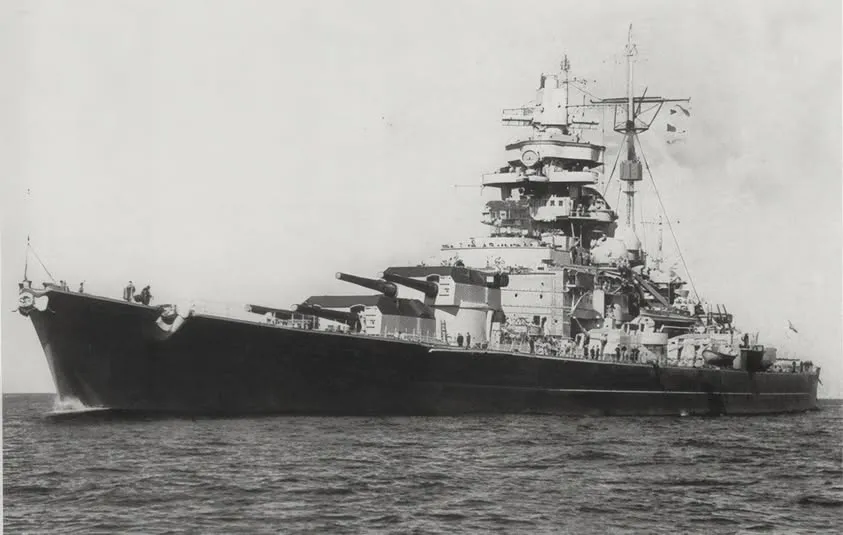
The Tirpitz, sister ship to the infamous Bismarck, stood as one of the most formidable symbols of Nazi Germany’s naval ambition during World War II. Commissioned in February 1941, she was the second of the Bismarck-class battleships and the largest battleship ever constructed by a European navy. With a full-load displacement of over 52,000 tons and armed with eight powerful 15-inch (380 mm) guns, the Tirpitz was a floating fortress designed to challenge Allied supremacy in the North Atlantic and Arctic waters. Her very existence demanded that the Allies divert considerable resources to neutralize the threat she posed.
The Kriegsmarine intended Tirpitz to act as a fleet-in-being, tying down Allied forces without necessarily engaging in large-scale battles. Stationed primarily along the Norwegian coast, she threatened Arctic convoys en route to the Soviet Union, forcing the Royal Navy to maintain a constant presence in the treacherous northern seas. The sheer size and firepower of Tirpitz made her a strategic nightmare: even the possibility of her sortie into the Atlantic could disrupt vital supply lines and alter the course of naval operations.
The Allies were acutely aware of Tirpitz’s potential. Over the course of three years, they launched a series of audacious operations to neutralize her. One of the earliest and most daring was Operation Source in September 1943, which involved British X-class midget submarines. These tiny craft penetrated the heavily defended fjords where Tirpitz was anchored, planting explosives beneath her hull. The operation was a partial success: Tirpitz sustained serious damage, requiring months of repairs, but she remained afloat, a constant menace to Allied convoys.
Repeated air raids followed, each testing both the ingenuity and patience of Allied planners. From carrier-based strikes to heavy bomber raids, the Allies sought to exploit any weakness in Tirpitz’s formidable armor and extensive anti-aircraft defenses. Weather, terrain, and Tirpitz’s ability to relocate between fjords often frustrated these efforts. Yet, the persistence of Allied forces underscored the ship’s significance: Tirpitz was not merely a battleship but a strategic focal point whose destruction was deemed essential to secure the Arctic shipping routes and support the broader war effort.
It was not until November 1944, during Operation Catechism, that Tirpitz met her end. Using RAF Lancaster bombers armed with 12,000-pound Tallboy bombs, the Allies launched a precision attack near Tromsø, Norway. The bombs penetrated her armor and caused catastrophic explosions, capsizing the massive vessel. The sinking of Tirpitz marked the culmination of years of careful planning, daring operations, and relentless Allied determination. Her loss was a significant blow to the Kriegsmarine, effectively ending Germany’s threat to Arctic convoys and symbolically representing the declining power of Nazi naval forces.
Beyond her tactical significance, Tirpitz has remained an enduring subject of naval history, fascination, and legend. She represented both the pinnacle of battleship engineering and the limitations of such enormous warships in modern warfare dominated increasingly by air power and submarines. Her story illustrates the interplay of technological innovation, strategic planning, and human bravery on both sides of the conflict.
Today, the wreck of Tirpitz rests in the waters off Tromsø, a silent testament to a bygone era of naval warfare. Her legacy serves as a reminder of the massive stakes of the Battle of the Atlantic, the ingenuity of Allied forces, and the persistent tension between the promise of overwhelming firepower and the realities of modern combat. The Tirpitz, once a symbol of German naval might, now endures as a chapter in the broader narrative of World War II—a story of ambition, persistence, and ultimate destruction.Continue reading
Promoted Content


What Screwless Dental Implants Cost In 2025 (See Prices)
He Went Up the Mountain Before Dawn and Never Came Back.
Dawn came slowly to the high country that Friday, the kind of pale winter light that makes the m…A Mother, a Prophecy, and a List That Ended Two Lives.Lori was the kind of mother people pointed to in the church parking lot, the kind whose laughter sou…She Was a Domestic Violence Counselor and a New Mother in Pain—Until the Night She Crossed the Guardrail at Niagara Falls With Her Two Children.The spray at Niagara Falls always looked like breath from something alive.A white, constant exhale t…A Quiet Georgia Town, a 911 Call, and the Teen Girl Accused of Killing Her Parents as They Slept.The quiet rural calm of Tyus, Georgia, was torn apart by a crime so disturbing that even seasoned in…A Routine Call on a Quiet Summer Night Ended the Life of 26-Year-Old Officer Mohamed Said in Melvindale.The summer night of July 21, 2024, settled gently over the city of Melvindale, Michigan.The air was…
Powered by Metaconex
Leave a Reply