A date that should have passed like any other midsummer Sunday.

But instead, it has become a wound — raw, permanent, impossible to comprehend — for everyone who knew the Dobosz family, and even for those who learned about them only through the aftermath of the unimaginable.
Thomas Dobosz, 32.
Lauren Dobosz, 31.
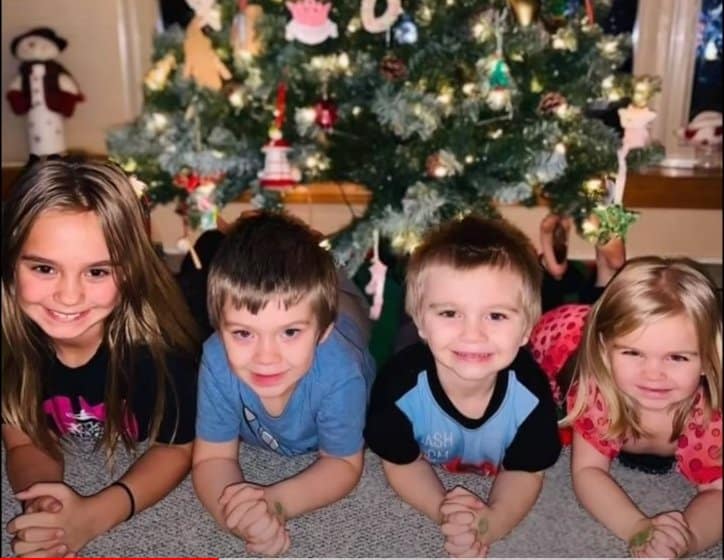
And their four children — Emma, 13; Lucas, 7; Nicholas, 6; and little Ella, just 5 years old.
They were headed westbound, beginning what relatives said was a family vacation.
A simple drive.
A hopeful drive.
A drive full of snacks, music, and small voices asking how much longer until they arrived.
A drive that should have ended with memories made on beaches or campgrounds or hotel pools.
But miles ahead of them, the night was twisting toward disaster.

A gray 2010 Acura TSX.
Traveling eastbound.
But somehow, impossibly, moving through the westbound lanes.
A wrong-way vehicle — one of the most feared and most unpredictable dangers on any highway — and no one knew why it was there or how long it had been traveling in the wrong direction.
The Acura closed the distance fast.
Too fast.
And then, without warning and without mercy, it struck the family’s Chevrolet head-on.
The impact was catastrophic.
It was violent.
It was instant.

And within moments, both vehicles erupted in flames — a blaze so intense that the fire seemed to swallow the night itself.
Witnesses described flames reaching into the sky, twisting and roaring, a tragic beacon alerting the world that something had gone terribly, irreversibly wrong.
Inside that inferno was a family.
A mother.
A father.
Four children.
And a visiting friend — 13-year-old Katriona Koziara, Emma’s companion, joining the family for what was supposed to be a joyful trip.
May you like
American War Hero & Coal Miner: The Story of Charles Dennis Buchinsky
A Lifetime of Valor: The Legacy of Colonel Hayden A. Sears
Operation Starlight: The Marines’ First Major Test in Vietnam
But joy had no chance against fate that night.
Lauren, Emma, Lucas, Nicholas, Ella, and Katriona were all pronounced deceased at the scene.
Thomas, the only survivor of the initial impact, was pulled from the wreckage alive but gravely wounded.
His injuries were severe.
Life-threatening.
Heartbreaking.
He was airlifted to the medical center, clinging to a breath that grew fainter with every passing hour.
Doctors tried.
Machines worked.
Prayers rose.
But pain does not negotiate.
And grief does not wait.

Days later, Thomas succumbed to his injuries — joining the family he had lost on that highway, leaving behind a community struggling to understand how an entire household could vanish in the span of a single collision.
The wrong-way driver, 22-year-old Jennifer Fernandez, was pronounced dead at the scene as well.
Her reasons for being in the wrong lane remain unknown.
Authorities have searched for answers — mechanical failure, impairment, confusion — but no explanation has ever brought comfort to those left behind.
Because how could it?
How could anything justify the extinguishing of seven young lives on what should have been an ordinary night?
Extended family members later confirmed that the Dobosz family had been headed on vacation.
A trip filled with excitement.
A trip the children had been counting down to.
A trip that will never be taken, except in the memories of those who loved them.
People who knew the Dobosz family describe them as warm and joyful.

Lauren was a devoted mother, always quick with a smile, always placing her children first.
Thomas was hardworking, gentle, loyal — a man who loved fatherhood and embraced it with pride.
Their children were full of dreams.
Emma, just 13, growing into her teenage years with curiosity and kindness.
Lucas, a playful 7-year-old with a grin that came easily.
Nicholas, six years old, energetic and sweet.
And Ella, five — the baby of the family — with her bright eyes and untold future.
Katriona, Emma’s friend, was loved by many as well — a girl whose parents believed they were sending her on a fun summer outing, never imagining the horror that awaited them.
This story seizes the heart because it is so brutally sudden.
So unfair.

So unbearably final.
It reminds us that life can change in an instant.
That joy can turn into tragedy with no warning.
That a family can be wiped from the earth not because of fate or illness or time, but because one car was somewhere it should never have been.
Highways are places of motion.
Places of purpose.
Places where families sing along to radios and children fall asleep with their heads resting on backpacks.
But that night, the highway became something else entirely — a line between life and death, a place where dreams dissolved into smoke.
The flames that consumed the vehicles also consumed futures — birthdays that will never be celebrated, graduations that will never be attended, milestones that will never come.
Communities across Illinois and beyond mourned the Dobosz family.

Fundraisers were held.
Vigils lit the darkness.
Photos of the children — smiling, carefree, full of happiness — circulated online, drawing tears from strangers who felt compelled to grieve for people they had never met.



Because grief, in its rawest form, connects us.
It always has.
It always will.
And this tragedy reminds us of the delicate balance that underlies every moment of our lives.
Why did it happen?
Why them?
Why then?
No one knows.
Maybe no one ever will.

But what remains — what must remain — is the memory of the family that once filled a van with laughter and anticipation.
A family bound for a vacation that promised joy.
A family that never arrived.
Tonight, as the world continues moving, some hearts remain suspended in that moment on July 31, 2022 — the moment when everything changed.
The moment when a wrong-way driver altered the lives of countless people forever.
The moment when seven beautiful lives were lost.
The moment when a community broke.
May the Dobosz family rest in peace.
May Katriona rest in peace.
And may we never forget the fragility of life, the unpredictability of the road, and the need to cherish every mile we travel with the people we love.
IT’S HERE! Elon Musk Confirms the 2026 Tesla Tiny House — Solar-Powered, AI-Driven, Under $8,000… and Hiding One Jaw-Dropping Secret Feature

The world expected electric cars.
It expected rockets.
It even expected humanoid robots.
But no one expected this.
Elon Musk has officially confirmed what was once only an internet rumor: the 2026 Tesla Tiny House is real, has launched ahead of schedule, and is already being called one of the most disruptive inventions in modern housing. Built with solar tech, AI-driven energy management, ultra-light materials, and a shockingly low starting price of $7,900, the Tesla Tiny House is redefining what “affordable living” can mean in the 21st century.
But what truly stunned the world wasn’t the price.
Or the design.
Or the technology.
It was the one secret feature Musk unveiled at the end of the presentation — a feature no one saw coming, and one that could completely change the global housing market.
Here’s the full story.
A Home Designed for a New Era
The Tesla Tiny House—known internally as Project Nomad—was designed around a simple idea Musk has repeated for years: “Housing should be high-quality, energy-independent, and affordable for everyone.”
At just 250 square feet, the home is compact but stunningly futuristic. Built from a new Tesla-developed composite that’s stronger than steel but lighter than aluminum, the structure can be transported using most midsize SUVs — including the Tesla Model Y.
Everything inside the home is designed around efficiency:
- Full roof solar array
- Powerwall Mini integrated into the floor
- Smart ventilation and temperature control
- Water recycling and filtration system
- Modular furniture that folds into walls
- AI energy manager “EVA” that learns your habits
This isn’t a trailer.
It isn’t a shed.
It isn’t a gimmick.
It is a fully functional, fully livable micro-home that can run off-grid indefinitely.
Under $8,000 — How Is That Even Possible?
Analysts were stunned by the pricing.
How can a solar-powered smart house cost less than a used motorcycle?
Tesla revealed the secret:
robotic manufacturing + ultra-light composite materials + flat-pack shipping.
Each tiny house is built in under six hours in a Tesla Megafactory by fully automated lines similar to those used for battery production. The panels fold into a flat shipping slab, reducing transport costs by 80%.
Musk emphasized:
“Housing is one of the last industries untouched by modern manufacturing.
We’re going to change that.”
This price point could shatter the barrier that has kept millions from owning a home.
Perfect for Anyone — Everywhere
The Tesla Tiny House was designed with massive flexibility:
✔ Off-grid living
✔ Backyard ADUs
✔ Travel homes
✔ Emergency housing
✔ Student housing
✔ Remote worker cabins
✔ Rentals and Airbnbs
✔ Homelessness relief shelters
Cities from California to Australia have already contacted Tesla about bulk orders.
Investors are calling it “the future of scalable housing.”
EVA — The AI That Runs Your Home for You
Inside every Tesla Tiny House is EVA, the new AI home assistant that makes the house feel alive.
EVA controls:
- Lighting
- Temperature
- Solar routing
- Battery usage
- Water system
- Air quality
- Security mode
She learns your routines within days. If you wake up at 6 a.m., EVA pre-warms the room and brews coffee. If clouds roll in, she automatically shifts energy storage to maintain power. If the temperature outside drops, EVA adjusts insulation panels in real time.
This is the first fully autonomous micro-home ecosystem ever released to the public.
But even with all this tech…
the biggest surprise was yet to come.
The Secret Feature That Shocked Everyone
Near the end of the announcement, Musk paused, smiled, and said:
“There is one more thing the world should know.”
The lights dimmed.
A low hum filled the room.
And then — the tiny house moved.
The entire structure slowly lifted three inches off the ground, hovered silently for ten seconds, and then gently lowered itself back down.
The audience erupted.
Musk explained:
The 2026 Tesla Tiny House comes with micro-levitation stabilizers.
Not for flying — not yet — but for:
- Earthquake stabilization
- Flood protection
- Perfectly level positioning
- Zero-ground-contact preservation
- Vibration-free living even in storms
The system uses miniature magnetic stabilizers similar to Tesla’s maglev cargo pods. During disasters, the house can lift itself above shifting ground or rising water long enough for evacuation.
No one had predicted this.
No leaks, no rumors — nothing.
A housing unit that can temporarily hover to protect itself? That alone could save thousands of lives in regions prone to quakes, storms, and floods.
The Internet Is Exploding
Within minutes, hashtags like:
#TeslaTinyHouse
#ProjectNomad
#MuskDidItAgain
were trending worldwide.
Some people want it as a vacation cabin.
Some want it as a doomsday shelter.
Some want to live in it full-time.
And millions simply want to see the levitation system up close.
Orders Just Opened — and Crashed the Site
Tesla announced that the first 10,000 units will ship in early 2026.
Within 12 minutes, the preorder page crashed.
By the end of the hour, all launch-edition units were sold out.
Musk tweeted:
“Demand is insane.
Increasing production capacity immediately.”
A Future Where Homes Are Smart, Mobile, and Affordable
The 2026 Tesla Tiny House is more than a product.
It’s a statement.
A challenge to the global housing crisis.
A new standard for sustainable living.
A shift toward mobility and independence.
And a symbol that the future of housing doesn’t need to be
expensive, static, or fragile.
Like Tesla’s first cars, its first rockets, its first solar roofs—
this is version 1.
And if history has shown anything, each version that follows will only get more advanced.
Elon Musk didn’t just build a tiny house.
He built a blueprint for how humanity may live in 5, 10, or 50 years.
Homes that power themselves.
Homes that think.
Homes that move.
Homes that protect.
A revolution has begun — one roof at a time.
And the world will never look at housing the same again.Continue reading
He Went Up the Mountain Before Dawn and Never Came Back.
Dawn came slowly to the high country that Friday, the kind of pale winter light that makes the m…A Mother, a Prophecy, and a List That Ended Two Lives.Lori was the kind of mother people pointed to in the church parking lot, the kind whose laughter sou…She Was a Domestic Violence Counselor and a New Mother in Pain—Until the Night She Crossed the Guardrail at Niagara Falls With Her Two Children.The spray at Niagara Falls always looked like breath from something alive.A white, constant exhale t…A Quiet Georgia Town, a 911 Call, and the Teen Girl Accused of Killing Her Parents as They Slept.The quiet rural calm of Tyus, Georgia, was torn apart by a crime so disturbing that even seasoned in…A Routine Call on a Quiet Summer Night Ended the Life of 26-Year-Old Officer Mohamed Said in Melvindale.The summer night of July 21, 2024, settled gently over the city of Melvindale, Michigan.The air was…
Powered by Metaconex


Leave a Reply